
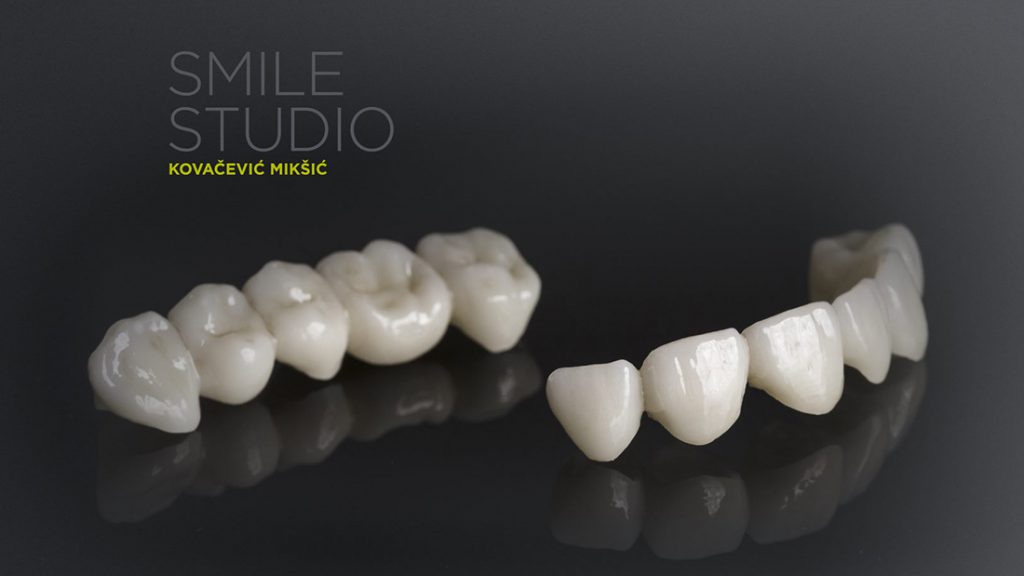
After dental implants, the most common solution for replacing missing teeth is ceramic crowns and bridges, which are the most similar to natural teeth both aesthetically and functionally. Until recently, metal-ceramic crowns were the best solution, but in recent years the aesthetically superior so-called metal-free ceramic crowns have taken over.
Metal-ceramic crowns
The base of a metal-ceramic crown is metal, onto which ceramic is fired. The metal base ensures the strength of the crown, while the ceramic gives it excellent aesthetics. For the colour to be as close as possible to a natural tooth, the metal must first be covered with a material that stops its grey colour from showing through, in other words to “mask” it. Only once this layer has been applied can the ceramic be “layered” in colours as each case requires.
A big advantage of these crowns is that each one can be fully customised, i.e. adapted to the situation so that it blends in with the rest of the teeth as well as possible. Even the smallest details can be imitated, such as brown or white spots, fine lines, tiny dips or bumps and cracks in the structure, in other words all the details we find on natural teeth. Until recently, these crowns were the peak of aesthetic dental care. Advances in technology have given us an aesthetically superior solution, the so-called metal-free ceramic crowns.

Zirconia ceramic crowns
The idea was to replace the metal base with a material closer in colour to the tooth, so that the special layer used to “mask” the metal would no longer be needed. This is where zirconia crowns come into play. The new materials used to make the bases are zirconium oxide and aluminium oxide.
Both are white-yellow in colour and have one extremely important property that is key to their aesthetics: translucency. Translucency is the ability to let light partly pass through, which is very similar to a natural tooth. They are exceptionally strong and ceramic can be fired directly onto them. Since they are translucent and leave room for more ceramic, the result is perfect aesthetics. In addition, metal-free crowns are made by computer, so the whole work is much more precise in terms of fit on the tooth, the junction with the gum and colour.
Once you have chosen the type of crown, the dentist needs to prepare the tooth. The tooth has to be reduced in thickness and height so that, together with the finished crown, it is the same size as the natural tooth.

Each type of crown also has its own rules for tooth preparation. Once the tooth has been prepared, an impression is taken and sent to the laboratory, where the technicians start making the crown.
The finished work is returned to the dental office and, if everyone is satisfied, it is cemented.
For all crowns, precise fabrication is very important so that the relationship with the tooth it is placed on and with the gum is perfect. The crown must fit the prepared tooth precisely. The margin should sit slightly below the gum line and must never stand away from the tooth, as this will lead to inflammation and gum recession. The crown should also be in contact with the neighbouring teeth so that food does not get trapped in between.
Besides precise fabrication, good oral hygiene is also very important for the longevity of the work. Of course, regular check-ups as agreed with your dentist are also essential.