

You know what a dental implant is, but you are not sure whether it is the right solution for you? Implants and implantology have been known since the 1960s. That is why we want to explain the concept to you, so that you no longer see it as a “bogeyman”, because it really is not!
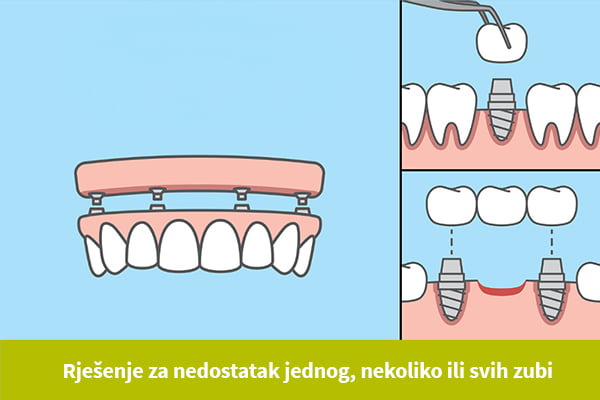
Losing a tooth is a very traumatic experience for every patient, both aesthetically and in terms of health. When you lose a tooth, you have not only lost the tooth: if you do nothing about it, you can also irreversibly lose part of the bone. This means that after a tooth is lost, changes occur in the bone, with a gradual reduction in volume, both in width and in height. This remodelling process is very fast and pronounced in the period immediately after the loss, and slows down over time. To prevent all this, we recommend placing a dental implant at the first opportunity. In the table below we list the situations in which dental implants are the perfect option:
| In which cases | Why implants are ideal |
|---|---|
| One missing tooth | The implant replaces the tooth without grinding down the healthy neighbouring teeth. |
| Several missing teeth | Several implants or a bridge on implants can be placed for a stable, permanent solution. |
| Complete toothlessness | All-on-4 or All-on-6 systems provide fixed teeth on just a few implants. |
| Patients who do not want healthy teeth ground down | Unlike a bridge, an implant leaves the natural teeth untouched. |
| Patients unhappy with their dentures | Implants offer stability and comfort, without the denture moving and without the need for adhesives. |
| Patients with stable general health and healthy gums | Ideal candidates for a high implant success rate. |
| Patients who want a long-term solution | With proper care, implants can last for decades or a lifetime. |
Dental implant placement
https://www.youtube.com/watch?v=kPp7su6VMTw
The advantage is that a dental implant can be placed during the same visit in which the tooth is extracted, which is actually the least traumatic option for you. It is done under the same anaesthesia, there is no need to open the mucosa later, and part of the implant bed already exists in the “socket” of the extracted tooth. This is what the complete implant placement process looks like from the beginning to the end of treatment:
| Stage of the procedure | Duration | What the patient can expect |
|---|---|---|
| Initial examination and planning | 1 visit | Clinical examination, X-ray/CBCT scans, treatment plan |
| Tooth extraction (if needed) | 30–60 min | Immediately if possible, but sometimes it is necessary to wait 2–6 weeks. |
| Implant placement | 30 minutes to 2 hours (depending on the number of implants) | Surgical procedure under local anaesthesia, painless |
| Healing and osseointegration | 3–6 months | The bone fuses with the implant, temporary tooth if needed |
| Abutment placement | 1 visit, 2–4 weeks of healing | Shaping of the gums |
| Fitting the crown/prosthetic restoration | 1–2 visits | Making and fixing the permanent crown or bridge, without anaesthesia because it is not painful |
This process reduces the number of visits, which is a very important factor nowadays. The way the tooth is extracted is also very important. The extraction should be as gentle as possible, that is, performed in a way that causes as little damage as possible to the bone structure (the socket, alveolus) that held the tooth. This is especially important if the implant is placed in the so-called aesthetic zone, the area that is visible when we speak or smile.
Bone grafting during dental implant placement
If the tooth was extracted earlier, bone loss has occurred by the time the implant is placed. Sometimes the bone loss is significant, and then it is necessary to replace the missing bone mass, which is particularly important in the aesthetic zone for the final result. Bone can also be destroyed as a result of long-standing inflammation of a tooth, or a fracture of the tooth and/or bone due to trauma. In each of these cases, the bone will most likely need to be rebuilt. If the defects are small, the grafting is done during the same visit in which the implant is placed. The material most often used for grafting is artificial bone mixed with the patient’s own bone. Before starting the whole procedure, an analysis must be carried out to determine whether bone augmentation (grafting) is needed and, if so, how much. Sometimes the bone defects are so large that they have to be dealt with first: new bone is placed, everything is left to heal, and only then are the implants placed.
The good news, however, is that today there are also different types of implants even for situations where bone density is insufficient. This means you can be a candidate for implant placement even if your bone may not be dense enough.
| Type of implant | Where they are used | Advantages | Limitations |
|---|---|---|---|
| Endosseous implants | In patients with healthy and sufficiently dense bone | High success rate (95–98%), long lifespan, wide range of use | Good bone volume needed, bone augmentation sometimes required |
| Subperiosteal implants | In cases of major bone loss, without augmentation | Faster placement, bone grafting is avoided | Shorter lifespan, higher risk of complications, rarely used in practice |
| Zygomatic implants | In cases of extreme bone loss in the upper jaw | Can be placed even in difficult cases, an alternative to All-on-4/6 | Complex procedure, requires a specialist, longer recovery |
As you can see, there is hardly a situation in which implants cannot be placed. But you can also conclude that it would be ideal to place an implant immediately after losing a tooth. At that point there is enough bone, so no additional bone procedures will be needed. In the end, this results in a shorter time to complete treatment and also a much lower cost.
The success of this kind of treatment depends on a number of factors, starting with good planning of the implant placement. This includes analysing a 3D X-ray, on the basis of which it is assessed whether the implant can be placed, followed by an examination of the patient, a professionally performed surgical procedure, and the type of implant the dentist places.
If you think you are a candidate for dental implantology, feel free to contact us. We will make sure that the satisfaction is mutual and long-lasting.
Recommended reading: