
Losing all your teeth is an emotionally and physically challenging event that affects several aspects of your life. Apart from the physical side, such as being unable to chew food, when you find yourself in a situation where you have lost most or all of your teeth due to illness or some other reason, your self-confidence will suffer the most. The good news is that today, thanks to modern dentistry, there are a number of options for replacing lost teeth, and the best way is precisely full dentures.
The question that arises with this topic is how to choose the best option among all those available? To help you choose, we have written today’s blog, in which we cover all the questions you may have: from the causes of losing all your teeth to when and why to opt for dentures, and we describe in detail all the options that exist.
Reasons for complete tooth loss

Complete tooth loss, also known as edentulism, can be caused by various factors that vary depending on age group, because yes, complete tooth loss can happen to anyone, regardless of age, although some groups are definitely more prone to this problem.
In adolescents and children, complete tooth loss is very rare, and the main reason for tooth loss is trauma, which happens due to falls and fractures during play or sports. Edentulism is also relatively rare in middle-aged adults. The frequency of edentulism in adults varies depending on various factors, including an individual’s oral health, genetic predisposition, lifestyle, socio-economic factors and access to dental care.
The group most often affected by complete tooth loss is older people. The frequency of edentulism in older people can be quite high and depends on various factors such as periodontal disease, genetic predisposition and general health, because health conditions such as diabetes, heart disease and osteoporosis can affect oral health and increase the risk of tooth loss. Also, with ageing, the jawbones lose density and volume, which further worsens the stability of the teeth. The combination of these factors makes older people more prone to tooth loss and edentulism.
Why opt for full dentures?

Missing all your teeth, regardless of the reason it happened, has a significant impact on a person on various levels, including physical, emotional and social.
Getting full dentures brings a number of advantages and benefits for the patient. Here are a few reasons why it is important to get full dentures in the case of complete tooth loss:
- Restoring chewing function: Full dentures allow a person to chew food effectively again, which improves eating habits and nutritional status.
- Restoring the aesthetics of your smile: Missing all your teeth can affect the appearance of your face and your smile. Full dentures restore volume to the face and ensure a natural-looking smile, improving self-confidence and social interaction.
- Preserving jawbone health: Wearing full dentures helps preserve jawbone density. Missing teeth can cause bone resorption, but dentures provide the necessary support and stimulation for the bone, which reduces jawbone loss.
- Preventing complications: Missing teeth can lead to various oral problems such as gum inflammation, stomatitis and infections. Getting full dentures can help prevent these complications and maintain oral health.
- Improving speech: Tooth loss affects the pronunciation of certain sounds and words. Full dentures improve a person’s ability to speak, allowing clearer and more fluent speech.
The decision to get full dentures is made in consultation with the dentist, who will assess the patient’s individual needs and goals and ensure the best possible solution, and in the rest of this blog we present the full denture options that exist so that you can get to know your options and ask your dentist about the one that interests you most.
What full denture options are there and what are their advantages and disadvantages?
Conventional full dentures

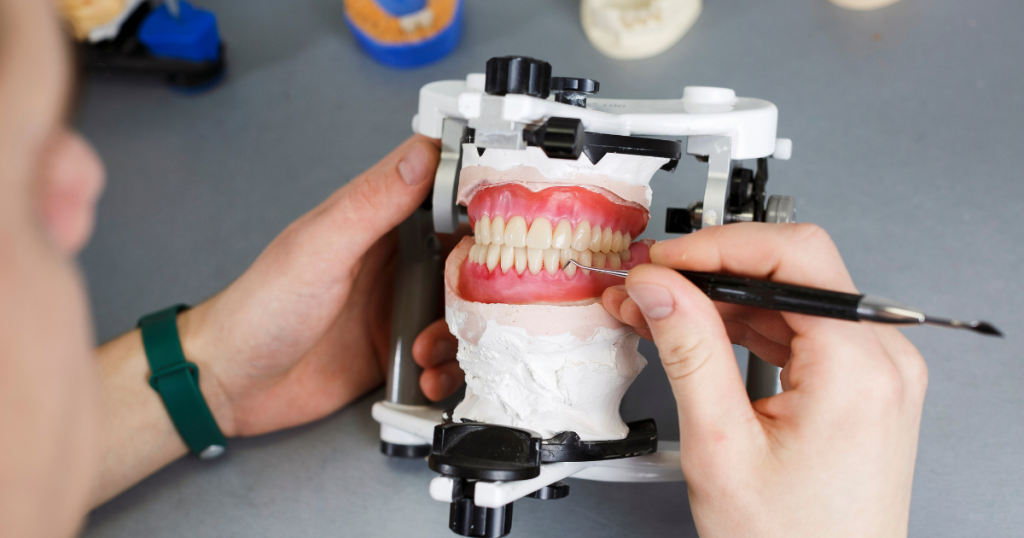
A conventional full denture is used to replace all the teeth in the upper or lower jaw. It is made of acrylic material and adapted to the anatomy of the patient’s jaw. A conventional full denture is the standard option for replacing all teeth, and it is also the most affordable, but unfortunately it also has the most disadvantages.
Advantages of conventional full dentures
- Affordability: Conventional full dentures are more affordable than other tooth replacements with implants, because of the material they use
- Simple fabrication: The process of making a conventional full denture is relatively simple and quick compared with other types of tooth replacement.
- Painless fitting: Fitting a conventional full denture is painless and does not require surgical procedures such as implants.
- Reversible option: Compared with other tooth replacements such as implants, conventional full dentures can be removed and replaced more easily if necessary.

Disadvantages of conventional full dentures
Although conventional dentures are a common choice for patients who suffer from toothlessness, after using this option patients very often complain about the same problems:
- Instability: Conventional full dentures can be less stable compared with other tooth replacements such as implants. Because they rely only on the lining of the mouth, patients very often feel that the denture will fall out or that it “dances” around in their mouth, which makes it hard for them to speak, eat and smile normally.
- Loss of taste: Because conventional full dentures cover the palate, a very common problem is losing the sense of taste of food.
- Need for adjustment: Conventional full dentures require a long adjustment period, especially in terms of bite and stability.
- Dietary restrictions: People who wear conventional full dentures often have difficulty with harder or stickier foods, as the dentures can be less stable in such situations.
- Need for regular maintenance: Conventional full dentures require regular maintenance and cleaning to prevent infections and maintain oral hygiene.
Implant-supported dentures
Another option for replacing all teeth is the implant-supported denture. These are dentures that combine elements of a conventional full denture with dental implants to increase the stability, security and comfort of the denture. An implant-supported denture is a much better choice than a conventional denture for several reasons.
Advantages of implant-supported dentures
- Increased stability: Dental implants provide a solid foundation for the denture, making it more stable during chewing, speaking and other everyday activities. This helps prevent the denture from moving and gives greater security and confidence when wearing it.
- Better function: Thanks to greater stability, a person wearing an implant-supported denture can chew food more effectively, which improves eating habits and nutritional status.
- Natural feel: Implant-supported dentures feel similar to a natural dental arch, because the implants act as replacements for the roots of the lost teeth. This results in a more natural feel and better function compared with conventional full dentures.
- Preserving the jawbone: Dental implants stimulate the growth and preservation of the jawbone, which can prevent bone resorption and reduce the risk of bone volume loss.
- Aesthetics: Implant-supported dentures provide a more attractive smile, because the implants integrate with the bone and allow a natural shape and position of the denture in the mouth.
Disadvantages of implant-supported dentures
- Financial cost: Implant-supported dentures are usually more expensive than conventional full dentures because of the cost of dental implants and surgical procedures.
- Longer treatment time: Placing dental implants can take more time than fitting a conventional denture, as it involves a surgical procedure to place the implants and time for the bone to heal before the denture is fitted.
- Need for sufficient bone density: Successful integration of dental implants requires adequate jawbone density and quality. A lack of bone density can limit the options for implant placement.
Despite some disadvantages, implant-supported dentures offer significant advantages over conventional full dentures, especially in terms of stability, function and aesthetics.
All-on-4 or All-on-6 dentures – the optimal solution for toothlessness
https://www.youtube.com/watch?v=Ushnj78EvH4
All on 4 Rijeka: The All on 4 placement process.
At first glance it may seem that you have to choose between an affordable solution with many drawbacks and an option that is a fantastic choice but also considerably more expensive. Fortunately, the truth is completely different. The dental industry is constantly advancing and trying to create a combination that offers patients an effective solution bringing together two options that at first seem completely opposite. That is exactly the revolution in the industry: the all-on-4 and all-on-6 concept.
The “All-on-4” and “All-on-6” concepts are innovative dental techniques used to replace all the teeth in the upper or lower jaw with dental implants. These techniques were developed to provide a stable and functional solution for patients who have lost many or all of the teeth in a jaw. If we compare them with the standard option of implant-supported dentures, all-on-4 or all-on-6 dentures are better options for several reasons:
- Fewer implants: All-on-4 and All-on-6 dentures use fewer implants compared with traditional implant-supported dentures. This reduces the number of surgical procedures needed, shortens treatment time and makes the procedure simpler and less invasive.
- Faster procedure: Thanks to the smaller number of implants, the procedure for fitting All-on-4 or All-on-6 dentures is usually faster and less complex than the procedure for implant-supported dentures. This means less time spent at the dental practice and a faster recovery time.
- Affordability: Fewer implants also means lower treatment costs, which makes All-on-4 and All-on-6 dentures more affordable for many patients compared with traditional implant-supported dentures.
- Suitable for lower bone density: All-on-4 and All-on-6 dentures can be a better choice for patients with lower jawbone density, because the implants are placed at an optimal angle and are used to make the most of the available bone.
- Stability and function: Although they use fewer implants, All-on-4 and All-on-6 dentures provide satisfactory stability and function, allowing the patient to chew food effectively, speak with confidence and feel secure in everyday activities.

To sum up. Conventional full dentures, although they are the most popular option for replacing all teeth, are also the oldest option and have the largest number of disadvantages. A much better option is implant-supported dentures, because of their security and durability as well as their aesthetic appearance. The drawback of this option, however, is a considerably higher price. The optimal option that combines the advantages of conventional full dentures and implant-supported dentures is the all-on-4 or all-on-6 denture.
| Solution for toothlessness | Description | Advantages | Disadvantages |
|---|---|---|---|
| Conventional full denture | Removable solution that rests on the gums | Low price, quick solution | Less stability, discomfort, need for adhesives |
| Implant-supported denture (overdenture) | Denture that attaches to 2–4 implants | Better stability than a conventional denture, simple maintenance | Still removable, needs to be taken out and cleaned |
| All-on-4 | Fixed bridge on 4 implants per jaw | Fixed solution, excellent aesthetics, function, quick treatment | Less distribution of forces than with All-on-6 |
| All-on-6 | Fixed bridge on 6 implants per jaw | Greater stability and longevity, a more natural feel and excellent distribution of forces. | Slightly higher cost compared with All on 4 |
We hope we have managed to answer the most common questions about choosing full dentures and helped you choose the solution that will suit you best. When choosing full dentures, first talk to your dentist so that you understand all the options and can adapt them to your needs and goals as well as your means.
Visit us at Smile Studio and book a free consultation and check-up so that together we can find the optimal solution for replacing all your teeth, improve your quality of life and bring the smile and confidence back to your face.