
We decided to explain in a bit more detail what a tooth is made of, because patient education is a fundamental part of prevention. Only healthy, well cared for teeth will serve you for many years. To take the importance of oral hygiene more seriously and understand it better, read on to learn more about tooth anatomy.
ANATOMICAL PARTS OF A TOOTH
From an anatomical point of view, a tooth consists of three parts. These are the crown, the neck and the root of the tooth.
Tooth crown
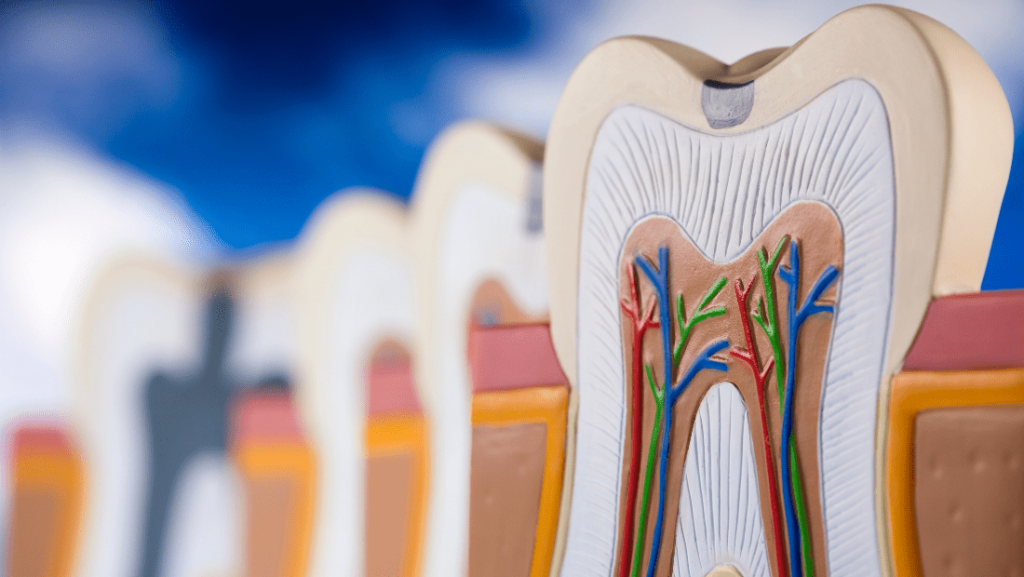
The crown is the functional part of the tooth visible above the gums or gingiva. It is made mostly of dentin covered by enamel. In the centre, beneath the dentin, is the pulp chamber filled with dental pulp (blood vessels and nerves).
Tooth neck
The neck is the narrowing where the crown and the root of the tooth meet, that is, where enamel and dentin meet. Like the root, this part is usually not visible because it is covered by the oral mucosa. Between the tooth and the mucosa there is a narrow space up to 1.5 mm deep, called the physiological pocket.
Tooth root
The root is the invisible part of the tooth that supports it and anchors it in the jaw. The root is attached to the jawbone by a fibrous ligament called the periodontal ligament.
Most of the hard tissue of the root is formed by dentin, which is covered on the surface by a thin layer of cementum. In the central part of the root, beneath the cementum and dentin, are the root canals. They are an extension of the pulp chamber from the crown and are filled with dental pulp.
At the very end of the root, called the apex, there is an opening through which blood vessels and nerves pass.
The number of roots depends on the tooth in question, so a tooth can have one, two or three roots.

Tooth structure
When we talk about the structure, i.e. the histological make-up of a tooth, we should mention enamel, dentin, cementum and pulp as the most important parts.
Enamel
Tooth enamel covers the outer surface of the crown. Its most important functions are to enable us to chew and to act like a shell protecting the inner, more “sensitive” parts of the tooth.
It is the hardest part of our body, with over 95 per cent mineral content and only 3 per cent water. Its thickness varies from 2.5 to 1.3 mm. It is thickest on the parts directly exposed to chewing forces, while the sides are thinner. Its colour is grey or bluish-white and it is partly transparent.
Because enamel is translucent, the colour of the dentin and of any restorative material beneath the enamel has a significant effect on the colour of the tooth.
Dentin
Dentin lies beneath the enamel and is yellowish in colour. It is permeated by tiny channels. When enamel is damaged, heat and cold reach the tooth through these channels. That is when the familiar tooth sensitivity appears. Minerals make up 70% of its structure, which tells us it is softer than enamel.
Cementum
Dental cementum is the tissue that covers the dentin on the root of the tooth. The main role of cementum is to serve as a medium that connects the tooth to the bone by means of ligaments, more precisely to the jaw.
It is thickest at the root tip and where the roots branch, and it is permeated by a system of channels. In composition it is similar to bone, with a mineral content of 45%, which makes it softer than enamel and dentin.
Cementum and dentin have regenerative properties, which means they are formed throughout life.
Dentin, enamel and cementum are hard dental tissues, unlike the pulp, which is a soft tissue.
Pulp

In everyday speech the pulp is often called the “nerve”, which is not entirely accurate. The pulp is in fact a soft tissue made up of blood and lymph vessels, nerves, collagen and elastic fibres and connective tissue cells.
Its primary function is to form dentin. It also has a nourishing role, supplying blood and nutrients, and a sensory function: registering temperature and mechanical and chemical stimuli. Its volume is very small, on average 0.02 cubic centimetres.
Over the years the pulp gradually shrinks as dentin is laid down.
Diseases of the pulp are dealt with by the branch of dentistry called endodontics.
Now you can see that a tooth is not just a “tooth” but a very complex organ. Who would have thought that something so small could be so complex? We hope we have not made it too complicated. If you have any further questions about tooth structure, we will be happy to answer them.