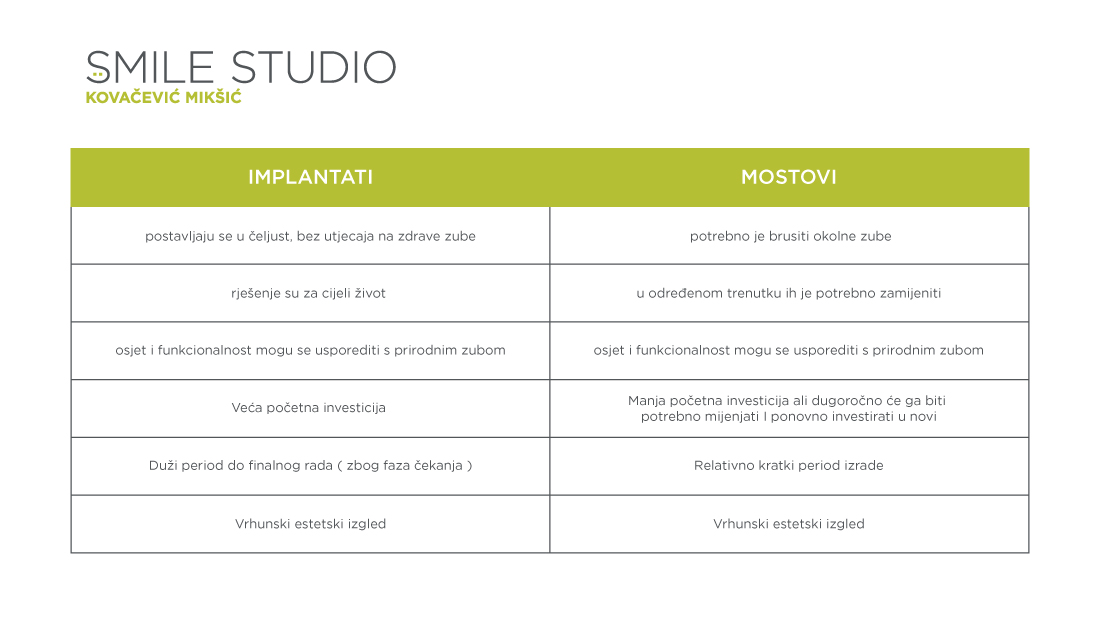


When a single tooth is missing, there are two possible solutions. The first is making a bridge and the second is placing an implant. In this article we will try to explain what each involves and when each of these solutions is used.
DENTAL IMPLANT
What is an implant?
An implant is a bone insert that replaces a lost tooth and is made of high-quality material (titanium). It consists of two parts. The first part is placed in the bone and, we could say, imitates the root of the tooth. After some time, the second part is placed on it, which serves as the connection between the implant and the prosthetic restoration, i.e. the crown.
When is it used?
By placing an implant we permanently solve the problem of a single missing tooth. Implants are cared for like natural teeth, so oral hygiene and proper maintenance are very important. Implants behave like natural teeth and restore all oral functions to their original state. Dental implants also support the structure of the face, especially the cheeks and mouth, and contribute to a younger appearance. The main requirement is good, healthy, high-quality bone. Besides looking and functioning like a natural tooth, an implant replaces the tooth without sacrificing the integrity of the neighbouring teeth.
The implant placement process
1. Medical examination
To determine whether you are a candidate for implant treatment, the dentist must carry out detailed examinations, including analysis of a panoramic and a 3D X-ray of the jaw, and examine you to assess your general health and the state of your oral hygiene.
2. Implant placement
This is a minor surgical procedure that is painless because it is performed under local anaesthesia, and there is hardly any pain after the procedure. There is only slight swelling, which can be reduced by regularly applying ice in the first few days. Many patients think it is a procedure that takes a lot of time, but they are surprised to learn that it usually takes less time than an “ordinary” tooth repair, i.e. a filling (30-45 min).
After placement, there is a period of 3 to 6 months during which the implant stays in the bone and “rests” until it has fully fused with the bone, after which the prosthetic restoration phase begins. This period can be longer or shorter depending on the case, and it is decided by the treating dentist. During this time the implants are inside the bone and covered with mucosa, so they are “invisible” in the mouth. While the implant is integrating, the patient has a temporary solution.
3. Taking an impression
Once the healing period is over, the implants are “uncovered”. The mucosa above them is removed and healing caps are placed so that the soft tissue around them heals and takes a shape that will later copy, as aesthetically as possible, the natural “emergence” of the tooth from the gum. The caps stay in place for 15-20 days, after which they are removed and an impression is taken, on the basis of which the final prosthetic restoration is made. Taking the impression takes 30-45 minutes, and the dental laboratory needs 3-7 days to make the crown from it.
4. Fixing the prosthetic restoration
In this step, which takes 20-45 minutes, the new tooth is placed, which will permanently replace the missing natural tooth in both appearance and function. The dentist will show you how to care for the implant and the new tooth.
Bridge
What is a bridge?
A dental bridge is a fixed prosthetic restoration that replaces one or more lost teeth and is made up of crowns. The usual and simplest is a three-unit bridge, where the middle tooth is suspended and attached to two teeth, one on each side, that serve as its base. If we do not fill the gaps between the teeth, we risk the other teeth in the mouth starting to shift, and that is just one step away from losing a proper bite and developing periodontal disease.
When is it made?
We make a bridge when we want to replace one or more teeth. To make it, the surrounding natural teeth that serve as supports need to be prepared (ground down).
The bridge-making process
1. Examination
In the first step, we will analyse your current condition and wishes, suggest the best treatment and prepare a detailed quote.
2. Tooth preparation and taking an impression
The teeth are prepared and an impression is taken for making a crown or bridge. A temporary solution is made and placed to stand in for the permanent work. The procedure takes 45-120 min. The dental laboratory needs 2 to 5 days to make the metal/zirconia base for the metal-ceramic or zirconia ceramic crown or bridge.
3. Try-in
The next step is the try-in of the metal or zirconia base for the future work, which takes only 20-45 minutes. For simpler work, this phase can be skipped. The time between the try-in and the permanent fixing of the crown or bridge is 1 to 5 days, which is needed to make the necessary adjustments and finish the prosthetic work.
4. Fixing the prosthetic restoration
The final phase is the permanent fixing of the crown or bridge, which takes 30-60 minutes.