
As you know, lost teeth should be replaced as soon as possible to prevent overloading and shifting of the remaining teeth. There are several ways to replace teeth, and they can be divided into fixed and removable.
Fixed restorations cannot be taken out of the mouth and patients experience them as their own teeth. These include crowns or bridges on natural teeth or implants. If a fixed restoration is not possible, the teeth you have lost can be replaced with removable restorations. Removable restorations include the partial denture and the complete denture. In today’s article we will explain a little more about when we use a partial denture .


What is the difference between a complete and a partial denture?
Unlike a complete denture, a partial denture is made when there are still a few teeth left in the jaw. This way, the remaining natural teeth help hold the denture in place. This makes the denture more stable when speaking and chewing. It is important to stress that the natural teeth that will support the denture must be healthy.
https://www.youtube.com/watch?v=NGg_u2uQnv8&list=TLGG9jRbQLeHus0xNTEwMjAyNA
Partial denture
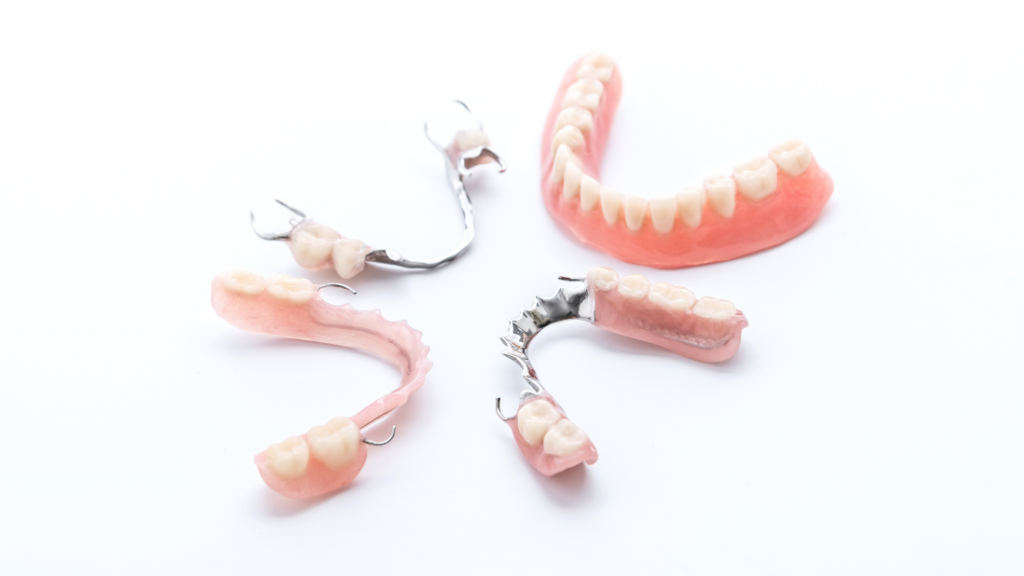
There are two types of partial dentures:
- acrylic
- cast metal framework (skeletal)
Acrylic partial denture

An acrylic partial denture is made entirely of acrylic, a synthetic material whose colour imitates the gum tissue. Since acrylic has relatively poor mechanical properties, the base has to be fairly wide and thick so that it does not break. Because of its size, this kind of base is harder to get used to.
Skeletal (cast metal) partial denture

In addition to acrylic, a skeletal partial denture also has a metal reinforcement. The metal, as the framework of this denture, provides exceptional strength, which allows the acrylic base to be reduced as much as possible, making the denture much more comfortable to wear.
Partial dentures and their parts
All types of dentures consist of three parts: the base, the teeth and the elements that attach the denture to the teeth. To stop the denture from “dancing” around in your mouth, it needs to be attached to the existing teeth in some way. The elements used for this are various types of clasps, which are the most common solution, but certainly not the best one. Besides clasps, there are much better connections, called attachments: clips and bars.
Advantages and disadvantages of partial dentures
The advantage of a partial denture is that, thanks to the remaining natural teeth, part of the chewing forces is distributed onto them. This makes chewing more comfortable and natural. In addition, thanks to the clasps on healthy teeth, speech and bite are more secure. Other advantages are their price and quick production. The biggest disadvantage is precisely this removability, which patients find hard to get used to and accept.
If you do not like this removable solution, there is always a fixed solution in the form of crowns and bridges on natural teeth or implants. The differences between these solutions are considerable: in materials, placement, quality, durability and price. Which one is ideal depends on your preferences, but also on the condition of your teeth. Book your free first check-up so that together we can choose the best solution for your dental problem.