
We are sure you have all heard of fillings or composite fillings. Today’s blog is dedicated to “super fillings”, that is, ceramic fillings.
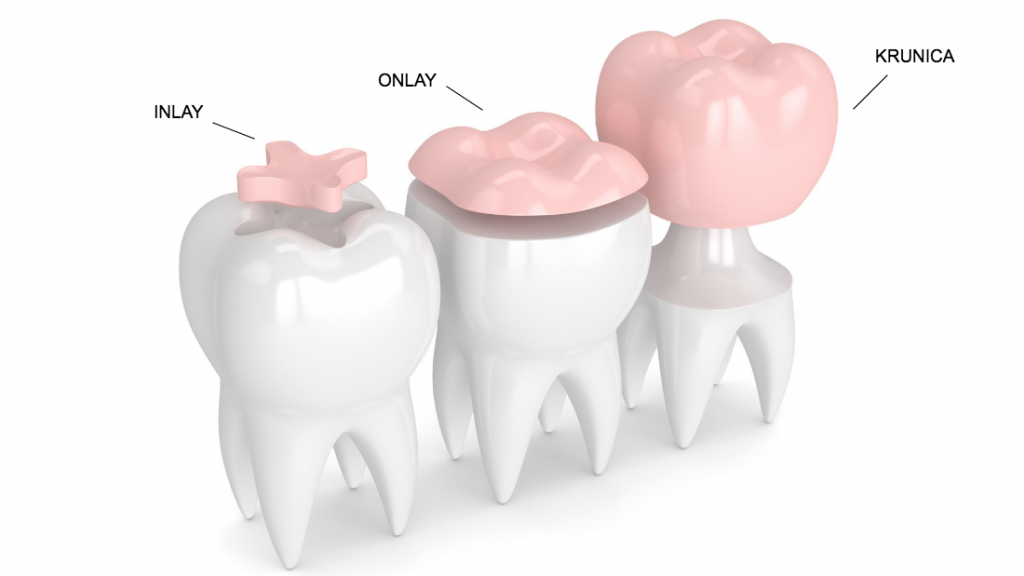
There are three types of ceramic fillings: inlay, onlay and overlay, and they differ in size. This is a rare and little-used solution, which is why most people are not familiar with it.
So what are ceramic fillings? They are fillings made in a laboratory by dental technicians, and they replace missing parts of the tooth in cases of larger damage.
Inlay, onlay and overlay ceramic fillings
The name of this type of filling depends on its size and the way it is anchored to the tooth
Inlay
An inlay (in = inside) is a filling that is placed into the tooth. It replaces the central part of the tooth, while the side walls are preserved.
Onlay
An onlay (on = on top) is a somewhat larger filling. It is placed on the tooth and, in addition to the central part, it replaces one or more of the side walls.
Overlay
An overlay filling covers a much larger part of the occlusal or biting surface, covering two or more cusps of the tooth crown.
How they are made
Since these fillings are made in a dental laboratory, the method of making them is completely different from that of standard fillings, which are made and shaped directly in the mouth.
If the loss of tooth tissue is larger and an agreement has been reached with the patient, the tooth needs to be prepared. Once the decay has been removed and the tooth prepared so that the filling can later be placed into or onto it in the final phase, an impression is taken. The impression goes to the laboratory, where the inlay, onlay or overlay is made. When the technician has finished, the completed filling is returned to the practice. It is tried in the mouth and compared with the colour and shape of the tooth, and if everything is right, the filling is cemented into the previously prepared tooth.
Making this kind of filling takes longer and the patient has to come to the practice at least twice, but in the end the result is the highest-quality method of replacing tooth structures, both in terms of material quality and aesthetics.
Advantages of ceramic fillings
Detailed workmanship
The advantage of this method is that the technician has plenty of time to make the filling. As a result, the end product is a perfectly shaped filling that fully imitates the colour and natural parts of the tooth.
Durability
Another big advantage of these fillings is their durability. The porcelain and composites used have better mechanical properties than standard white fillings. For this reason, the possibility of micro-cracks forming is reduced to a minimum.
Wider range of use
Compared with composite fillings, ceramic fillings can repair larger tooth damage. In addition, unlike veneers and crowns, ceramic fillings are a less invasive solution because they do not require much grinding of the tooth.
If you have any further questions or would like to check whether ceramic fillings are the right solution for your needs, feel free to contact us, we are here for you.