

It is easy to think that losing teeth will not cause you problems. Unfortunately, the long-term consequences of tooth loss can be quite serious. Dental implants can help you avoid these risks. We already know from previous blog posts that implants can be a lifelong solution for replacing teeth. Allon4 and Allon6 are implant systems used when you are missing most or all of the teeth in a jaw. Read our new blog to find out when each of these solutions is used and what the difference is.
The difference between the systems
Number of implants
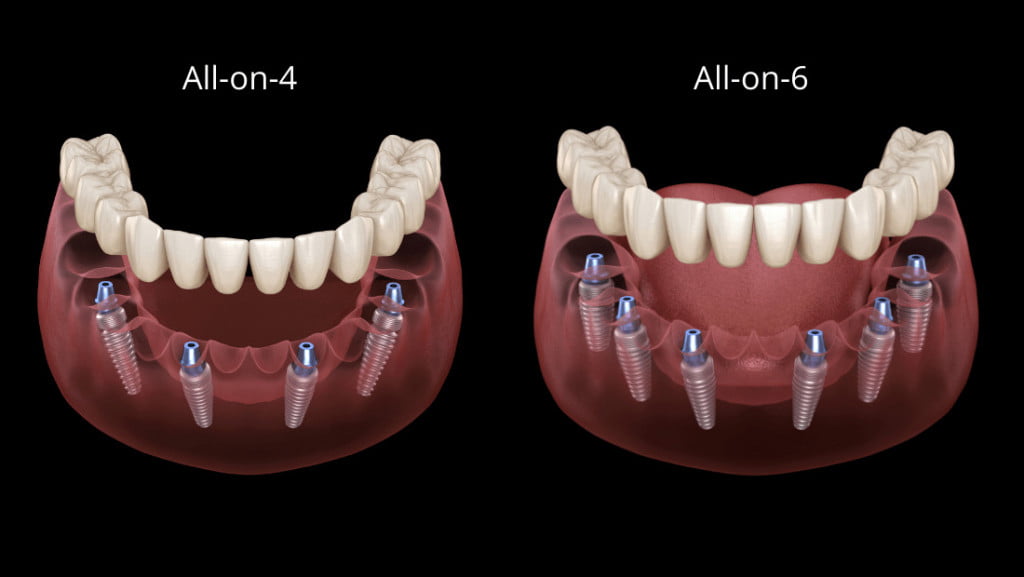
The first thing you notice is the difference in the number of implants. This number refers to the number of implants placed in each jaw. So with the AllOn4 concept, four implants are placed in the upper or lower jaw, and with the All on 6 concept, six implants.
Position of the implants
In the All on 4 concept, two implants are fixed in the back areas (between the fifth and sixth tooth), while the other 2 are fixed vertically in place of the front teeth. In the AllOn6 concept, four implants are fixed vertically in the back areas and the remaining two in the front areas.
Strength
The two additional implants in the AllOn6 concept provide greater stability for the bridge structure and a better distribution of chewing forces. With AllOn6 you can count on greater strength and structural integrity of the restoration. However, let us not forget that more implants also means higher costs.
When to choose 4 and when 6 implants
AllOn4 is the ideal solution for patients who have worn a full denture for many years and have experienced severe bone loss over time. Today, All on 4 is the most commonly recommended dental implant solution. Four implants still provide enough stability and strength to support a fixed dental bridge for life.
The AllOn6 method is the best option functionally and aesthetically, with an excellent long-term prognosis. It is always better to have as many supports as possible for the prosthetic work, so this method is an excellent solution for toothless jaws. However, bear in mind that in some situations, because of a small amount or poor quality of bone, only a limited number of implants can be placed.
The All-on-4 and All-on-6 implant placement procedure
| Stage of the procedure | Duration | What the patient can expect |
|---|---|---|
| Consultation and planning | 1 visit | Examination, CBCT scan, treatment plan and agreement |
| Extraction of remaining teeth (if needed) | 30–60 min | Often in the same session as implant placement |
| Surgical placement of implants | 2–3 hours per jaw | Placement of 4 or 6 implants under local anaesthetic |
| Fitting the temporary bridge | Same or next day | The patient goes home with fixed temporary teeth |
| Healing and osseointegration | 3–6 months | The implants fuse with the bone while the patient uses the temporary bridge |
| Fitting the permanent bridge | 3–5 visits | Making and fixing the permanent bridge (acrylic, composite, zirconia) |
There is no universal answer to the question of which of these two solutions to choose. Your dentist will assess the condition of your jaws and teeth and recommend the best solution for you. If anything is unclear, feel free to ask us.