

Losing a tooth does not only affect the look of your smile. It can make chewing and speaking harder, change the way your teeth meet, and over time affect the bone and the surrounding teeth. That is why it is good to learn about all the options for replacing a lost tooth in good time.
One of them is dental implants: a stable solution that can replace one tooth, several teeth or all the teeth in a jaw. The implant takes on the role of the root of the lost tooth, while a crown, bridge or denture is placed on top of it. Treatment is always planned individually, after an examination and the appropriate diagnostics.
In this guide we explain what a dental implant is, who it is recommended for, what the placement looks like, how long recovery takes, what the lifespan of an implant depends on and which questions you should ask before starting treatment.
In short: Implant placement is usually carried out under local anaesthesia. After placement there is a healing period during which the implant fuses with the jawbone. When the implant and the surrounding tissues are ready to bear load, the permanent restoration is made. The whole process can take several months, and the exact duration depends on the condition of the bone, the number of implants, the need for additional procedures and the planned prosthetic solution.
What is a dental implant and how does it work?
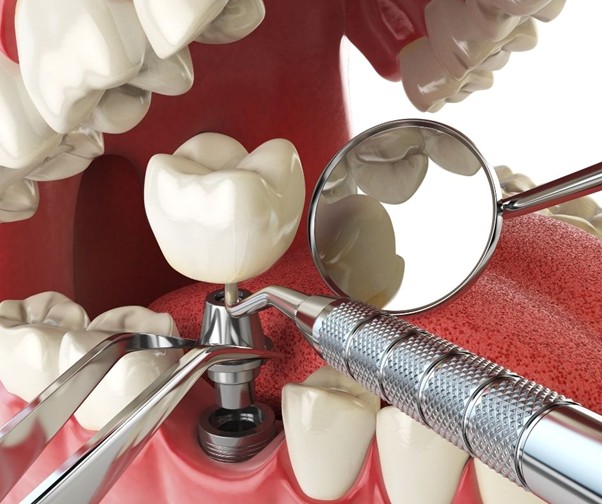
A dental implant is a small post, usually made of titanium, that is surgically placed in the jawbone in place of the lost tooth root. Its job is to create stable support for a future tooth or several teeth.
When we talk about a “tooth on an implant”, we are actually talking about a system that usually consists of three parts:
- the implant, which sits in the bone and takes on the role of the root
- the abutment, the connecting part between the implant and the restoration
- the crown, bridge or denture, the visible part that restores the function and appearance of the tooth
After placement, the process of osseointegration begins: the surface of the implant fuses with the surrounding bone. This process needs time and stable healing conditions. Only when the implant can safely bear load is the permanent restoration placed on it.
Read more about implant solutions on the page Dental implants at Smile Studio.
When are dental implants used?
Implants can be considered in different situations:
- when one tooth is missing
- when several teeth in a row are missing
- when teeth are missing in several places in the jaw
- when all teeth are missing, as support for a fixed bridge or a stabilised denture
- when the patient wants to avoid grinding down healthy neighbouring teeth, if the clinical situation allows an implant solution
- when an existing removable denture is not stable or comfortable enough
It is important to know that an implant is not automatically the best choice in every situation. Sometimes a bridge, a denture or another type of prosthetic treatment is more suitable. The decision depends on the condition of the neighbouring teeth, the amount and quality of the bone, gum health, general health, the patient’s expectations and their ability to maintain oral hygiene.
What can happen if you do not replace a lost tooth?
After a tooth is lost, more than just an empty space is left in the mouth. Depending on the position of the tooth and the condition of the rest of the teeth, the neighbouring teeth may gradually tilt or shift, and the tooth in the opposite jaw may grow longer towards the gap. This can change the bite, make cleaning harder and increase the load on the remaining teeth.
At the same time, the bone where the tooth was removed naturally remodels and shrinks, because there is no longer a root putting functional load on it. The changes vary from person to person, but over time they can make later implant placement harder or increase the need for bone grafting.
This does not mean that every lost tooth has to be replaced with an implant straight away. It means that it is useful to have an examination and a plan in good time, even if the treatment will not be carried out immediately.
Implant, bridge or denture: what is the difference?
Each of these solutions has its place in dentistry. The best choice is not the same for every patient.
| Solution | How it replaces teeth | Potential advantages | What to take into account |
|---|---|---|---|
| Dental implant | Placed in the bone and supports a crown, bridge or denture. | Does not require grinding down neighbouring teeth; a stable and functional solution. | Requires a surgical procedure, healing time, suitable bone and good maintenance. |
| Dental bridge | Rests on the neighbouring teeth. | A quicker prosthetic solution without implant placement. | The neighbouring teeth have to be prepared and ground down; hygiene under the bridge needs special attention; the bridge needs replacing after more than 10 years. |
| Removable denture | Rests on the gums and/or the remaining teeth. | Can replace a larger number of teeth without implants. | Can be less stable; it has to be taken out and maintained regularly. |
When one tooth is missing, an implant often allows it to be replaced without involving the healthy neighbouring teeth. If the neighbouring teeth already need crowns, a bridge may make additional sense. When several teeth are lost, there are often several combinations of implants and restorations, so a good plan is more important than a solution chosen in advance.
Who is a candidate for dental implants?
A good candidate usually has satisfactory general health, healthy or treated and stable gums, and enough bone for implant placement. If there is not enough bone, this does not automatically mean that an implant is not possible: sometimes bone grafting can be carried out or a different treatment approach chosen.
Before deciding, the dentist assesses:
- the health of the gums and whether there is active periodontal disease
- the amount and shape of bone at the planned implant site
- the position of nerves, sinuses and neighbouring teeth
- the bite and the distribution of forces when chewing
- habits such as smoking and teeth grinding
- general illnesses, how well they are controlled and the medication the patient takes
- whether the patient can maintain the necessary oral hygiene and attend check-ups in the long term
Active gum disease must first be treated and stabilised. Smoking, poorly controlled diabetes, certain health conditions and some medications can increase the risk or require an adapted plan. That is why it is important to tell your dentist about all diagnoses, medications and supplements you take, even if they do not seem related to your teeth.
Age on its own is usually not the only criterion. In younger people it is necessary to wait until jaw growth is complete, while for older patients the decision is based more on health, the condition of the tissues and the ability to maintain the implant than on the number of years.
What does preparation for implant treatment involve?
Good implant treatment starts before the surgical procedure. At the first consultation we talk about the problem, your wishes, your health and the possible solutions. After the teeth and gums are examined, the necessary X-rays are taken, and in more complex situations a three-dimensional (CBCT) scan as well.
Diagnostics help determine:
- whether there is enough bone and whether bone grafting is needed
- the optimal position, diameter and length of the implant
- how to avoid important anatomical structures
- what the final position and appearance of the future tooth will be
- whether a temporary tooth can be placed and when the implant can bear load
The implant is not planned separately from the crown or bridge. The goal is to predict the final functional and aesthetic result from the start, and then place the implant in the position that best suits that result.
What does the dental implant placement procedure look like?
The exact course differs from patient to patient, but treatment usually includes the following stages.
1. Examination, diagnostics and treatment plan
After the examination and analysis of the X-rays, the patient receives a treatment proposal, an approximate timeline and a quote. At this stage we discuss alternatives, expectations, possible risks and the need for a temporary solution.
2. Preparing the mouth
Before implant placement, active inflammation, tooth decay and gum disease are treated. If a tooth still needs to be extracted, the implant can be planned immediately after the extraction, after a few weeks or after more complete healing. The timing depends on infection, the condition of the bone walls, the soft tissues, aesthetics and the possibility of achieving implant stability.
3. Surgical implant placement
The procedure is usually carried out under local anaesthesia. Once the area is numb, the site in the bone is prepared and the implant is placed in the planned position.
During the procedure the patient may feel touch, pressure or vibration, but should not feel any pain. If they do feel pain, it is important to tell the dentist straight away so that the anaesthesia can be adjusted.
For a simple placement of a single implant, the procedure is often relatively short. It takes longer if several implants are placed or if a tooth extraction, bone grafting or another additional procedure is carried out at the same time.
4. Healing and osseointegration
After placement, the implant needs time to fuse firmly with the bone. This period often lasts several months. How long it takes depends on the jaw, bone quality, implant stability, additional procedures and individual healing.
The patient does not necessarily have to be without a tooth during this time. Depending on the position and conditions, a temporary solution can be made that does not interfere with the healing of the implant.
5. Making and fitting the permanent tooth
When the dentist confirms that the implant is ready to bear load, an impression or a digital scan is taken. Based on it, the dental laboratory makes the crown, bridge or other prosthetic solution. After it is fitted, the fit, appearance, speech, bite and ease of cleaning are checked.
1. Examination and diagnostics
Examination, X-rays and an individual treatment plan.
2. Preparation
Treating any inflammation and preparing the mouth.
3. Implant placement
The surgical procedure is usually carried out under local anaesthesia.
4. Healing
Over several months the implant fuses with the jawbone.
5. Permanent tooth
A crown, bridge or other prosthetic solution is made and fitted.
Read a more detailed description of each stage in the article What is the dental implant placement process and how long does recovery take?
Can an implant be placed straight after a tooth extraction?
It can, but only when the conditions are favourable. Immediate implant placement means that the implant is placed in the socket on the same day the tooth is extracted. The advantage can be a shorter overall treatment time and fewer procedures, but this approach is not suitable for everyone.
The decision depends on the condition of the bone and gums, the presence of infection, the position of the tooth, aesthetic requirements and the possibility of achieving good initial implant stability. In some situations it is safer to wait for the soft tissue or bone to heal.
There is also an important difference between immediate implant placement and immediate loading. An implant can be placed straight after an extraction, but that does not mean a tooth used for full chewing can always be attached to it straight away.
Is implant placement painful?
This is one of the most common questions patients ask. The procedure is normally carried out under local anaesthesia, so you should not feel pain during the placement itself. You may feel pressure, vibration or touch.
When the anaesthetic wears off, sensitivity, mild to moderate pain, swelling or a small bruise are to be expected. The intensity depends on the extent of the procedure and the individual reaction. The discomfort can usually be kept under control with the medication and instructions prescribed by the dentist, and it gradually eases over a few days.
Pain that gets worse instead of easing, heavy or prolonged bleeding, increasing swelling, a temperature, pus, an unpleasant taste or a loose restoration are reasons to contact the practice as soon as possible.
How long is recovery after implant placement?
After a simple placement of a single implant, many patients can return to lighter everyday activities the very next day. With a larger number of implants, bone grafting or a more extensive procedure, more rest may be needed. Recovery is individual, so returning to activities should follow your dentist’s instructions.
In the first days, softer food is usually recommended, along with avoiding strenuous physical exertion, alcohol and smoking, and careful oral hygiene according to individual instructions. Do not change the prescribed medication on your own or take antibiotics “just in case”.
Exact post-operative instructions always take priority over general advice from the internet, because they depend on the type and extent of the procedure carried out.
When is bone grafting needed?
An implant needs adequate bone support and must be placed in a position that allows a functional, aesthetic and easy-to-clean restoration. If there is not enough bone in height or width, augmentation, or bone grafting, may be necessary.
A lack of bone can develop after a tooth has been missing for a long time, after an extraction, periodontal disease or trauma, or because of the anatomy of the sinuses and jaw. Depending on the extent, grafting can be carried out before implant placement or at the same time.
Bone grafting makes treatment longer, but it can create more stable and predictable conditions for the implant. Whether it is needed can only be reliably assessed after an examination and X-rays.
How long do dental implants last?
Dental implants have very good long-term predictability. Systematic reviews of research show high implant survival rates even after ten years, but “survival” does not mean that a check, repair or replacement of an individual prosthetic part will never be needed.
The implant in the bone, the abutment and the crown are not the same part and do not age in the same way. A crown can wear down, chip or need replacing over time, while the implant can remain stable. On the other hand, inflammation of the tissue around the implant can lead to bone loss and put the implant at risk.
Lifespan is affected by:
- the quality of the planning and surgical placement
- the position of the implant and the quality of the restoration
- gum health and a history of periodontitis
- daily oral hygiene
- regular professional check-ups and cleaning
- smoking
- control of diabetes and other important health factors
- teeth grinding and excessive load
That is why an implant should be seen as a long-term medical and prosthetic solution that requires lifelong maintenance, not as a part that is placed and then forgotten.
Can implants fall out or be "rejected" by the body?
An implant is not “rejected” in the same way as a transplanted organ. However, it can happen that in the early stage it does not fuse sufficiently with the bone, or that it loses support later on.
Early failure can be linked to healing, infection, insufficient stability or loading too early. Later problems are more often linked to inflammation of the tissue around the implant, bone loss, smoking, poor hygiene or excessive load.
Signs that need an examination include:
- bleeding or swelling of the gums around the implant
- pus, an unpleasant taste or persistent bad breath
- new or increasing pain
- receding gums
- a loose crown, bridge or implant
- discomfort or a change in the bite when chewing
A loose crown does not always mean that the implant itself is loose: sometimes the problem is the screw or another prosthetic part. That is why it is important not to try to fix the problem at home, but to contact your dentist as soon as possible.
How do you look after dental implants properly?
An implant cannot get tooth decay, but the tissues around it can become inflamed. Bacterial plaque can cause peri-implant mucositis, an inflammation of the soft tissue, and without timely treatment the inflammation can progress to peri-implantitis and affect the bone.
For long-term care it is important to:
- brush your teeth at least twice a day using the recommended technique
- clean around the implant, under the bridge and between the teeth every day with suitable interdental brushes, floss or another recommended aid
- use a water flosser if your dentist recommends it, but not as a substitute for mechanically removing plaque
- attend individually scheduled check-ups and professional cleaning
- get in touch if bleeding, swelling, pain, an unpleasant taste or looseness appear
- protect the restoration with a splint if you grind or clench your teeth and your dentist recommends it
Check-ups do not only look at whether the implant is “firm”. The gums, the depth of the space around the implant, bleeding, hygiene, the bite and the condition of the restoration are assessed and, if needed, the bone level on an X-ray.
Read more about the connection between implants and diseases of the tooth-supporting tissues in the article Dental implants and periodontal disease.
How much do dental implants cost?
When a patient asks about the price of an implant, it is important to clarify whether this means only the implant in the bone or the whole new tooth. The total cost of treatment can include diagnostics, surgical placement, the implant, the abutment, a temporary restoration, the permanent crown or bridge, check-ups and any additional procedures.
The price is most often affected by:
- the number and type of implants
- the type and extent of the restoration
- the material of the crown or bridge
- the need for tooth extraction, bone grafting or a sinus lift
- the complexity of the procedure and the need for a temporary solution
- the chosen implant system and components
That is why the lowest advertised price for one part of the treatment is not always the same as the final price of a new tooth. After the examination, the patient should receive a clear plan listing the stages, what is included in the price and which additional procedures might be needed.
Why the implant system matters, and so does the whole team
Frequently asked questions
Everything you need to know
Not always. One implant usually supports one crown when a single tooth is missing, but when several teeth are lost, a few implants can support a bridge. The number of implants is determined by the layout of the teeth, the bone, the bite and the type of prosthetic solution.
It is often possible to provide a temporary aesthetic solution, but it does not always have to be attached directly to the newly placed implant. Immediate loading is only allowed when implant stability and the other clinical conditions are favourable.
Simpler cases often take a few months. If tooth extraction, healing, bone grafting or a more complex restoration is needed, treatment can take longer. An exact timeline can only be given after diagnostics.
As a rule, some kind of temporary solution is planned, especially in the visible area. Its type depends on the implant site, the number of teeth and the need to protect the implant from load while it heals.
It is possible, but the active disease must first be treated and stabilised. People with a history of periodontitis have a higher risk of problems around implants and need consistent hygiene and individually planned check-ups.
Sometimes they are, with bone grafting, a regenerative procedure, a sinus lift or a different implant and prosthetic plan. In some situations another solution is more suitable. The assessment is based on the examination and X-rays.
The frequency is not the same for everyone. It is determined by the health of the tissues, a history of periodontitis, the quality of hygiene, smoking, diabetes, the type of restoration and other risks. For some, less frequent check-ups will be enough, while others will need a more frequent maintenance programme.
They can last for decades, but there is no guarantee that they will last a lifetime without complications. Their lifespan depends on biology, how the treatment was carried out, habits and maintenance. The prosthetic part may need repair or replacement over the years even when the implant is stable.
Thinking about dental implants?
The most important first step is not choosing an implant, but getting an accurate diagnosis and a plan that takes into account your whole mouth, your health and what you want to achieve.
At Smile Studio in Rijeka, implant treatment starts with an examination, an analysis of the available X-rays and a conversation about the possible solutions. After that, you can receive an individual treatment plan, the expected duration and a clear financial quote
If you are missing one or more teeth, book an examination and find out which options are best for your situation.