
When patients ask us about the price of a dental implant, they actually mean the implant kit. The implant alone is not enough to replace a missing tooth or teeth. In this blog we will therefore explain what an implant kit consists of.
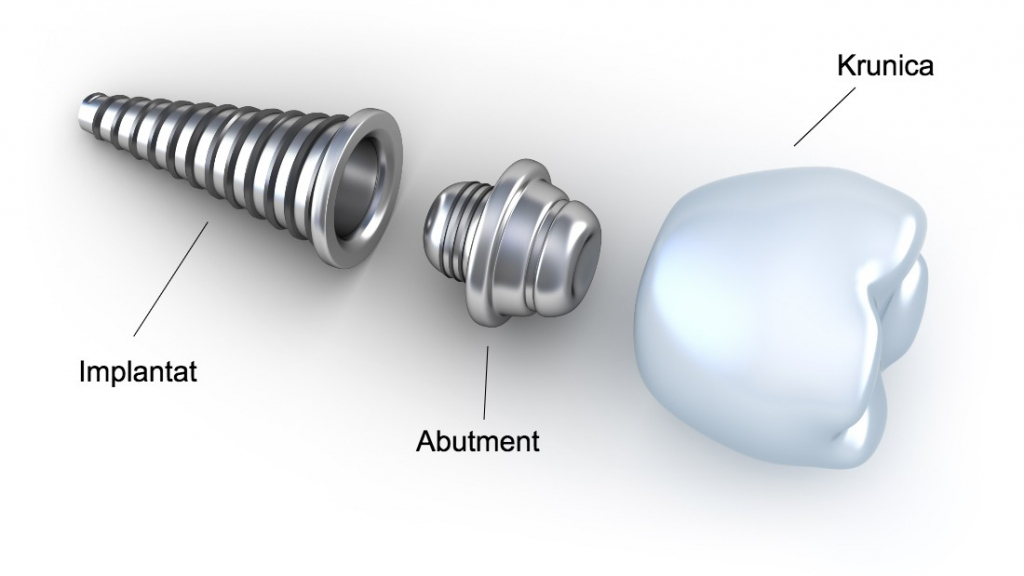
An implant kit consists of 3 parts. The first part is the screw that is placed into the bone. This is the implant in the true sense of the word but, as we said, without the other parts it has no function. The second part is called the prosthetic abutment, and it connects the implant and the prosthetic restoration. The third part is the prosthetic restoration itself, that is, the ceramic crown.
Dental implant or “screw”

As mentioned above, this is the part of the implant kit that is placed into the bone. Most implants are made of a biocompatible material, titanium. After some time the implant fully fuses with the bone, that is, it osseointegrates, just like a tooth. Some companies invest enormous effort in research into the implant surface to make this process as fast and successful as possible. Some of them are more successful and some less so, which is why it is very important that your dentist tells you which implants are being placed in your body. You can read more about this in “Dental implants: why the brand matters” and “The success rate of a placed implant is as high as 98%, which makes this surgical procedure one of the safest in dental medicine. The placement of the implant into the jaw itself is very quick, about 30 minutes. The procedure is painless because it is performed under local anaesthesia. Once placed, the “screw” takes over the role of the tooth root.
Depending on the density of the bone into which the first part of the implant is placed, there are different options that cover patients with sufficiently dense bone as well as those for whom this is not the case:
| Type of implant | Where they are used | Advantages | Limitations |
|---|---|---|---|
| Endosseous implants | In patients with healthy and sufficiently dense bone | High success rate (95–98%), long lifespan, wide range of use | Good bone volume needed, bone augmentation sometimes required |
| Subperiosteal implants | In cases of major bone loss, without augmentation | Faster placement, bone grafting is avoided | Shorter lifespan, higher risk of complications, rarely used in practice |
| Zygomatic implants | In cases of extreme bone loss in the upper jaw | Can be placed even in difficult cases, an alternative to All-on-4/6 | Complex procedure, requires a specialist, longer recovery |
After the implant is placed into the jaw, it takes 3-6 months for it to fully integrate into the bone. This resting period is called osseointegration. During this process the patient has a temporary solution.
Abutment or prosthetic superstructure

The abutment is made of titanium or zirconia and is the connector between the implant itself on one side and the restoration (crown, bridge, denture) on the other, acting as its support. It is fixed with a screw to the implant, which in the meantime has fused with the bone.
The abutment, or superstructure, is fitted 3-6 months after the implant is placed. This step is also painless and takes 10 minutes.
Prosthetic restoration
The prosthetic restoration is the solution for one or more missing teeth. If we are replacing one tooth, it is a crown, and if we are replacing several teeth, it can be a bridge.

For more information, read our other blogs about implants:
When to get a dental implant
Dental implants: why the brand matters
What to expect after implant placement